The birth of the automobile (Motorwagen) in 1886 and the first motorized transports 10 years later (1896).
100 years of Mercedes-Benz: The merger that created the "star".
Not one, not two, but 20 anniversaries Mercedes celebrates in 2026.
A milestone year for Mercedes-Benz in 2026
2026 is a landmark year for Mercedes-Benz, as it brings together not one, not two, but twenty anniversaries that capture the brand’s journey from the birth of the automobile to the modern era. Based on the most important milestones, the history of Mercedes-Benz unfolds through defining moments in technology, design, and motorsport.
The birth of the first automobile (Motorwagen) and the first transport applications
1886 marks the starting point of motoring: on January 29, Carl Benz filed a patent application for the first self-propelled vehicle in history, the Motorwagen, signaling the birth of the automobile. That same year, on March 8, Gottlieb Daimler laid the foundations for the first four-wheeled car with a high-revving engine.
Ten years later, in 1896, motorization expanded into transport. Specifically, on August 18 the first truck with an internal-combustion engine was unveiled, while on December 5 Benz & Cie. delivered the world’s first van, opening new paths for distribution and professional use.
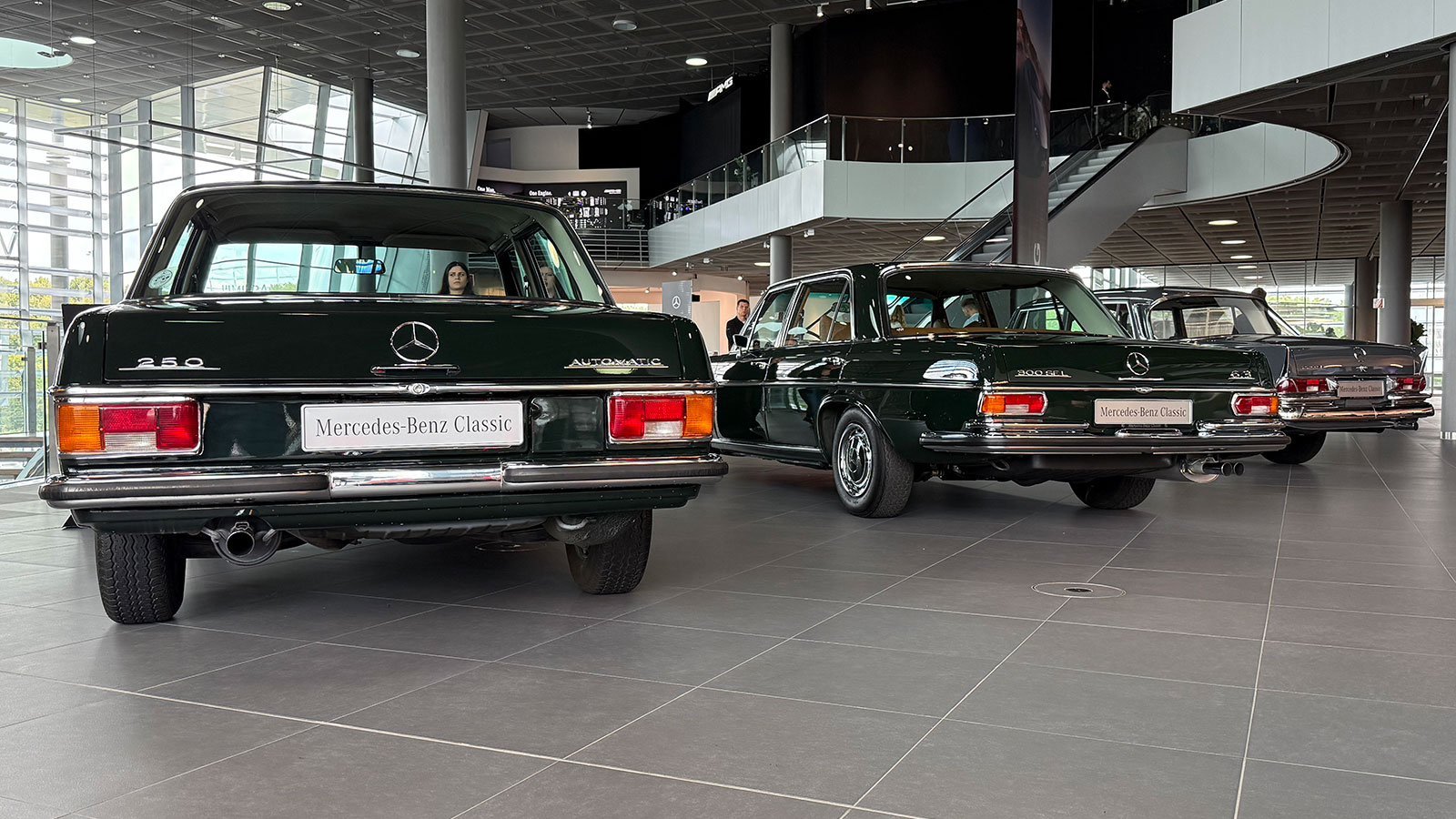
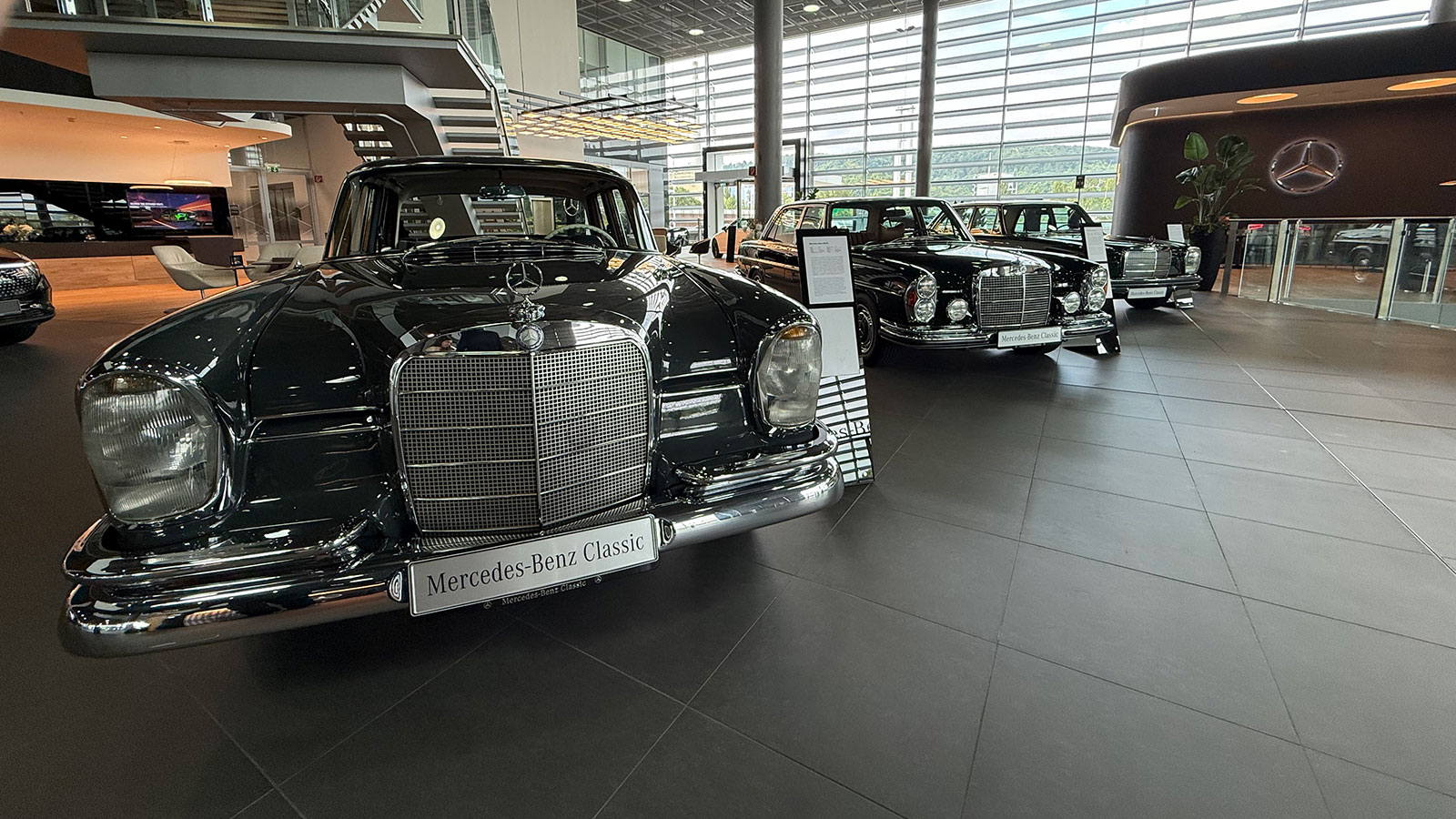
On the first floor of the Mercedes-Benz showroom in Stuttgart, right next to the premium brand΄s museum, some of its all-time classic models are on display.
100 years of Mercedes-Benz — The merger that created the “star”
But it took 1901—and Gottlieb Daimler—to turn Carl Benz’s bold ideas into reality and launch onto the market the first automobile, which was equipped with a grille to ensure proper cooling of the single-cylinder gasoline engine, like the grilles we see on today’s cars. 1901, then, was the year the Mercedes 35 PS dominated Nice Week, marking the entry into the “Mercedes era.” The decisive milestone came in 1926, when Benz & Cie. and Daimler-Motoren-Gesellschaft merged to form Daimler-Benz AG, giving birth to the Mercedes-Benz brand. That same year, innovation also extended to racing, with the first use of Alfred Neubauer’s signaling system for communication with drivers.
Ten years later, in 1936, Mercedes-Benz engineers created the first passenger car with a diesel engine, the 260D, which consumed nearly 30% less fuel than its gasoline equivalent. It is also noteworthy that as early as 1939, Mercedes had begun conducting crash tests using a special vehicle built with a very rigid frame featuring dedicated side-impact protection, aiming to increase the safety of its cars.
Mercedes established as a premium car manufacturer
The 1950s elevated Mercedes-Benz as a benchmark for luxury and safety. In 1951, the 300 (W186) and 220 (W187) models were introduced, precursors to the S-Class, and in the same year the patent application was filed for the safety body by Béla Barényi.
Also in 1951, the 300 S (W188) appeared as the fastest German production car of its time. At the same time, the Unimog—whose testing began in 1946—became established as a multi-purpose vehicle with a wide range of applications.
In 1976, the 123 model series was launched, which went on to become a milestone for the later E-Class, while that same year the C 111-II D set world records and class records at Nardò. In 1986, Mercedes-Benz introduced assistance systems such as ASR and ASD, as well as 4MATIC all-wheel drive. In 1978, the Mercedes S-Class made history as the first production car to be optionally equipped with the anti-lock braking system (ABS).
The 1990s brought new categories: in 1996, the Mercedes SLK with the retractable vario-roof hardtop made its debut, and in the same year a C 36 AMG became the brand’s first official Safety Car in Formula 1.
20 years since the opening of the Mercedes-Benz Museum
In 2001, the SL R 230 was introduced with a wealth of innovations, while in 2006 the Mercedes-Benz Museum opened, evolving into an international point of reference for the brand's history. That same year, Bernd Schneider won his fifth DTM championship, setting a timeless record.
With 140 years since the invention of the automobile, 130 years of motorized transport, and 100 years of Mercedes-Benz, 2026 sums up a journey defined by consecutive milestones. From the 1886 patent to modern achievements, the history of Mercedes-Benz remains an unbroken chain of innovation and progress.